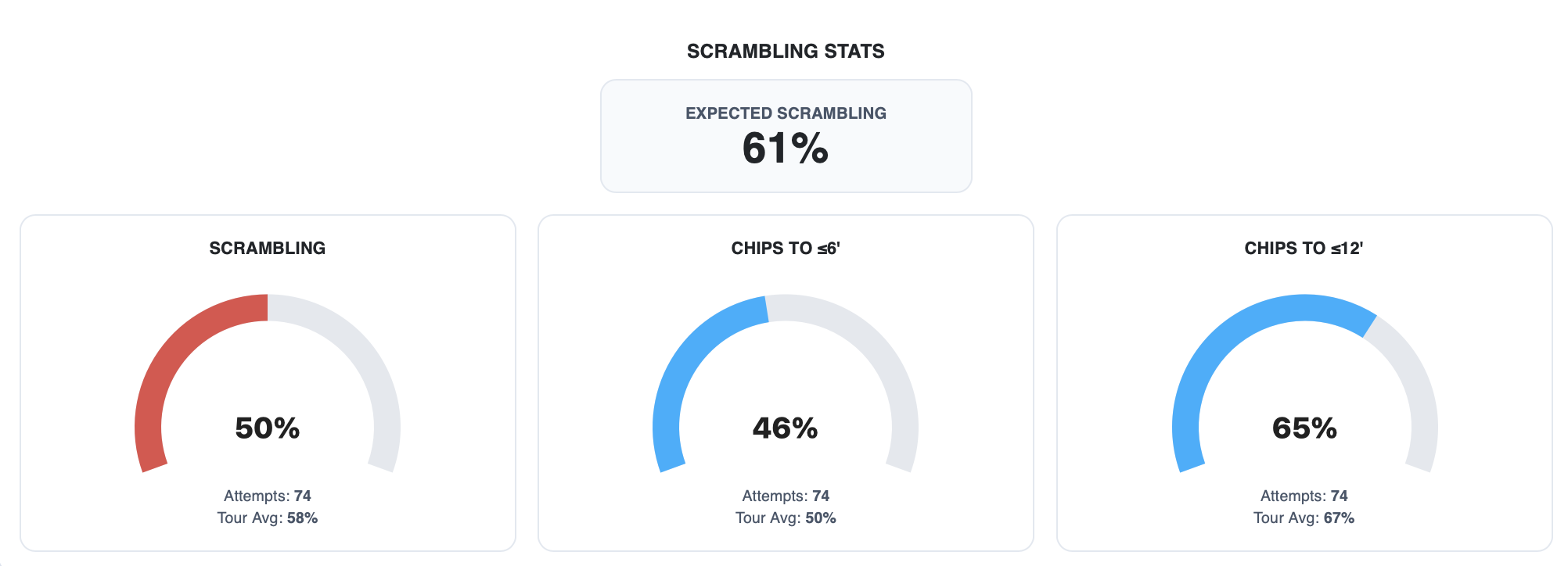
Scrambling rate is one of the most widely used stats in golf. It is on every tour leaderboard, every handicap app, and every coach’s clipboard. And for decades, it has been giving golfers a fundamentally incomplete picture of their short game.
The premise sounds reasonable: when you miss a green, how often do you still make par? If you get up and down 60% of the time, you are a solid scrambler. If you are at 40%, your short game needs work. Clean, simple, easy to track.
The problem is that scrambling rate does not actually measure how good your short game is. It measures outcomes — and it strips away almost all of the context that determines whether a short game performance was excellent, average, or poor.
What Scrambling Rate Gets Wrong
Here is the core issue: scrambling rate treats every missed green as the same situation. A chip from just off the fringe with a perfect lie and 40 feet to a back pin counts exactly the same as a buried lie in a greenside bunker with two yards of green to work with. Make par in both situations and you go 2-for-2. Miss par in both and you go 0-for-2.
But those are not remotely equivalent challenges. One is a situation most tour players convert more than 90% of the time. The other, even elite ball-strikers leave with a bogey on a regular basis. Treating them as identical makes scrambling rate almost meaningless as a diagnostic tool.
There is a second problem: scrambling rate tells you nothing about what happened on the shot itself. A chip that finishes six inches from the hole and a chip that finishes 15 feet away both count as a scramble attempt. The difference in shot quality is enormous — one relies on a made putt, the other gives you a genuine tap-in — but scrambling rate cannot see it.
And then there is the most practical problem for players trying to improve: scrambling rate cannot tell you where your strokes are actually going. Is your short game leaking shots from bunkers? From tight lies? From longer chips? From distance control on your pitch shots? The stat gives you a percentage. It does not give you a direction.
What Strokes Gained: Around the Green Actually Measures
Strokes Gained: Around the Green solves all three of those problems.
Instead of counting outcomes, SG: ATG measures the quality of every individual shot you hit from around the green — relative to the expected number of shots a benchmark golfer would need from that same position. Every shot has a starting value (based on distance, lie, and location) and an ending value. The difference between those two values, minus one stroke for the shot you just hit, is your strokes gained or lost on that specific shot.
That means a brilliant bunker shot that finishes inside three feet gains a lot. A mediocre chip that leaves you 20 feet away loses strokes, even if you happen to make the putt. The quality of the short game shot is evaluated on its own merits — not rescued or punished by what happens on the green afterward.
This separation is crucial. It means SG: ATG can isolate your actual short game skill from putting variance, which is exactly the kind of clean signal that helps you improve.
What the Data Actually Shows About Short Games
When you start tracking SG: Around the Green properly, a few patterns tend to emerge that scrambling rate completely hides.
The first is that most golfers lose more strokes from distance control on mid-range pitches than from any other short game category. Shots from 20 to 60 yards — the range where club selection, trajectory, and spin control all intersect — are where strokes quietly disappear without players realizing it. Scrambling rate does not differentiate these shots at all.
The second pattern is that bunker play is wildly inconsistent for most competitive amateurs and junior golfers, but scrambling rate averages it out. A player might convert sand saves at a decent rate in clean lies and absolutely hemorrhage strokes from buried or plugged lies, with the overall percentage masking the gap entirely. SG: ATG shows the buried lie problem directly.
The third pattern — and this is one that surprises a lot of golfers — is that the short game shots most players practice most (standard chip from just off the green, flat lie, no obstacles) are often among the least valuable shots to improve. The strokes gained data tends to point toward the uncomfortable shots: the awkward distances, the bad lies, the downhill pitches with speed to manage. Those are where the scoring opportunity actually lives.
What to Track Instead
If you want a genuine picture of your short game, here is what actually matters.
- SG: Around the Green by shot type (chip, pitch, bunker)
- Easy chip scrambling
- Chips hit to 6 feet
- Chips hit to 12 feet
Start With Honest Data
The short game is where most competitive rounds are decided. It is also the area where players are most likely to be working hard on the wrong things — because the traditional stat they are using to measure themselves does not actually show them where the strokes are going.
SG: Around the Green is not a more complicated version of scrambling rate. It is a fundamentally different kind of measurement — one that evaluates shot quality rather than outcomes, and gives you a clear direction instead of a percentage.
If you have been tracking scrambling rate and wondering why your short game practice is not translating to better scores, the answer is probably that you have been optimizing for the wrong signal.
Start with honest data. The strokes are in there.
If you want to see how your SG: Around the Green numbers break down by shot type and distance, PARfect Performance tracks all of it automatically. Start your one-month free trial at parfectperformance.com.
For more on what D1 coaches are actually looking for — and how your short game data fits into that conversation — have a look at our previous post: What D1 Golf Programs Actually Look for in Recruits