There is a problem that almost every college golf coach I talk to describes in some version of the same way.
They have the data. They believe in analytics. They know that strokes gained tells a more complete story than score alone. But between managing a roster , traveling to tournaments, recruiting, and running a program, there are simply not enough hours in the week to extract meaningful insight from all of it before the next practice session begins.
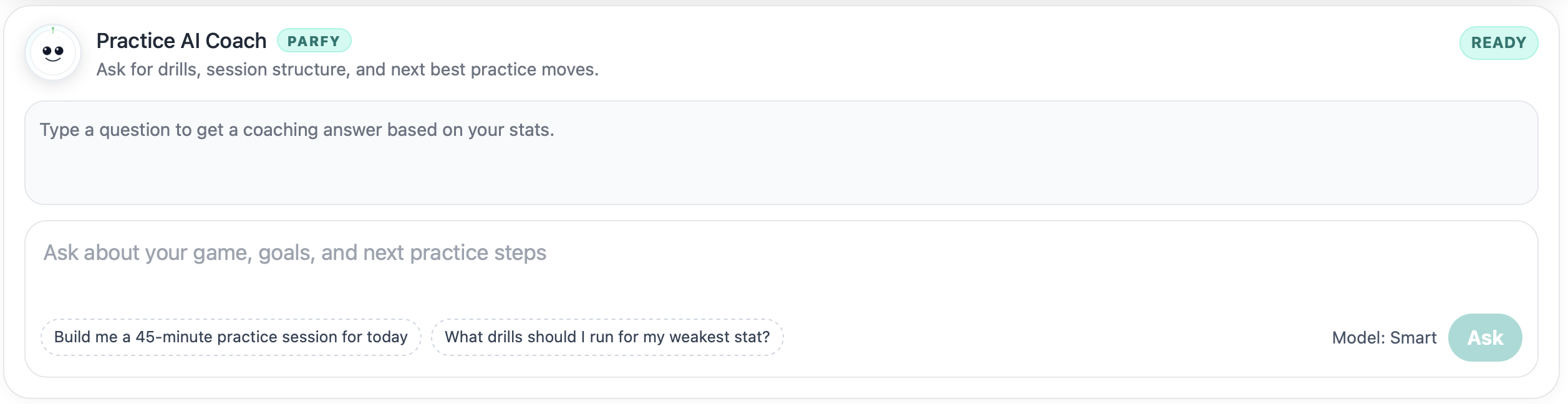
This is the bottleneck that Parfy — PARfect Performance’s AI chatbot — is built to solve. And the more I think about what AI actually enables in a college golf context, the more convinced I am that this is not a minor feature. It is a structural shift in what analytics can do for a program.
The Data Is Not the Problem
College golf has gotten better at data collection. More programs are tracking strokes gained. More players are logging rounds consistently. The tools exist.
But data collection and data interpretation are two completely different things, and the gap between them is where most programs lose the benefit of analytics entirely.
A coach managing 9 players through a five-round stretch of tournament play has roughly 36 rounds of data to process before the next practice session. If they are doing this manually — opening spreadsheets, cross-referencing benchmarks, looking for trends across a rolling sample — that is an enormous time investment. And it has to happen fast. College golf tournament cycles are compressed. You might play three events in four weeks. By the time you have finished manually reviewing the last event’s putting data across your whole roster, you are already on the bus to the next one.
The result is that most programs end up working with incomplete analysis. Not because the coaches are not skilled enough to interpret the data, but because there physically is not enough time to interpret it at the depth it deserves before it needs to be acted on.
What Parfy Actually Does
Parfy reads a player’s rolling data — typically their last 10 to 20 rounds — and generates a plain-language breakdown of where they are gaining or losing strokes, how their numbers compare to professional benchmarks, and what specifically the pattern suggests they should focus on.
For a player, this means they do not need to be a data analyst to understand their own stats. They enter their round, and Parfy tells them what the numbers mean and where to direct their next practice session.
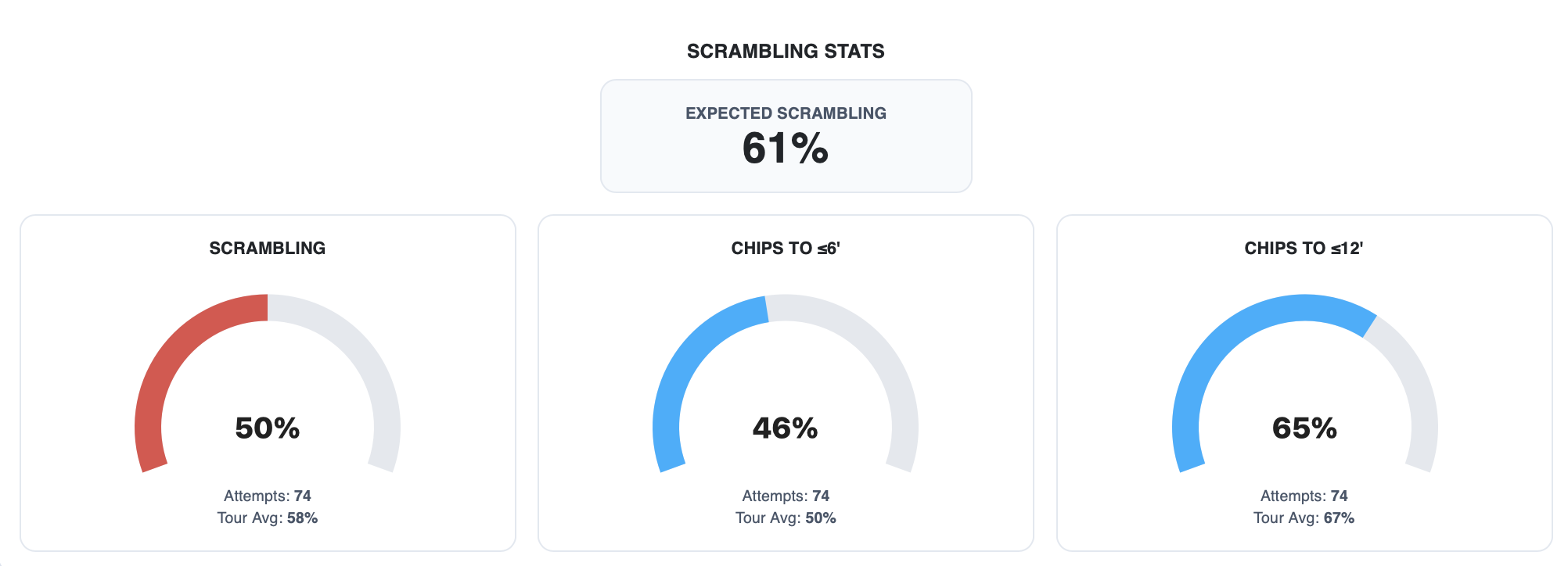
For a coach, the impact is different and arguably larger. Instead of spending Monday morning manually reviewing each player’s putting stats, a coach can pull up any player’s profile and get a full analytical summary in seconds. Player A is losing 0.4 strokes per round on putts inside eight feet. Player B’s three-putt rate has climbed four percentage points over the last three tournaments. Player C is statistically fine on the greens — their scoring issue is coming from approach play, not putting at all.
That changes everything about how you plan practice.
The Practice Planning Problem
One of the most underappreciated challenges in college golf coaching is practice structure at the group level. A team is not a monolith. On any given week, different players have different statistical weaknesses, different patterns, different priorities. Building a practice session that is genuinely useful for everyone requires knowing what everyone actually needs — not just what the team’s aggregate numbers suggest.
Without fast, accurate player-level analysis, coaches often default to one of two approaches: running generic team practice sessions that are useful on average but optimal for no one, or spending their limited preparation time doing manual analysis for only the players they are most concerned about and making gut-call decisions for the rest.
Parfy enables a third option. Because the interpretation is handled automatically, a coach can start each week with a clear picture of every player’s current statistical profile before practice planning even begins. That makes it possible to group players intelligently — putting players with similar pattern problems together at the appropriate station, identifying who needs volume work and who needs technical work, knowing in advance which conversations to have one-on-one and which issues can be addressed at the team level.
The practice session becomes a direct response to what the data actually showed, not a general maintenance session held together by instinct.
Speed Matters More Than People Realize
In college golf, the tournament cycle is short and the feedback loop is fast. A player can develop a meaningful pattern problem — losing distance control on longer putts, for example, or consistently giving back strokes on the 10-to-15-foot range — and that problem can quietly compound across three or four tournaments before anyone has had the time to identify it from the data.
With Parfy, the trend surfaces early. After the second tournament showing the same pattern, the system has enough context to flag it. A coach acting on that information after event two is in a completely different position from a coach who catches it after event five. The player saves strokes. The team’s results improve. And the coach’s credibility with the player — because the feedback is precise and data-backed rather than impressionistic — is stronger.
This is especially important for putting, because putting performance is statistically noisy at the individual round level. A player can three-putt four times in a round and still be trending positively across a rolling sample. A player can hole everything in sight on a given day and be masking a real pattern problem that will show up consistently. Without the AI layer aggregating and contextualizing across multiple rounds, coaches are often reacting to the wrong signal — one-round variance — rather than the actual trend that matters.
Why This Matters Now
AI in golf analytics is still early. Most tools in this space either serve recreational players at a surface level or are enterprise platforms too complex and expensive for college programs to adopt and maintain. The middle layer — powerful enough for genuine competitive use, simple enough that players actually log rounds consistently — is where PARfect Performance is building.
Parfy is the clearest expression of that. The goal was never to impress anyone with technology. The goal was to give coaches time back and give players clearer direction, so that the gap between having data and using data actually closes.
In college golf, where resources are limited, schedules are compressed, and margins between programs are thin, that gap closing is a real competitive advantage.
The programs that figure out how to turn data into daily practice decisions faster than their competition will have an edge that compounds over time. Not because they have access to different information, but because they are actually using the information they already have.
That is what Parfy is built for. That is what we are working toward.
Have a look at our previous post to get more insight into the world of golf statistics and PARfect Performance: Putting Stats Are Lying to You (Here’s What to Track Instead)