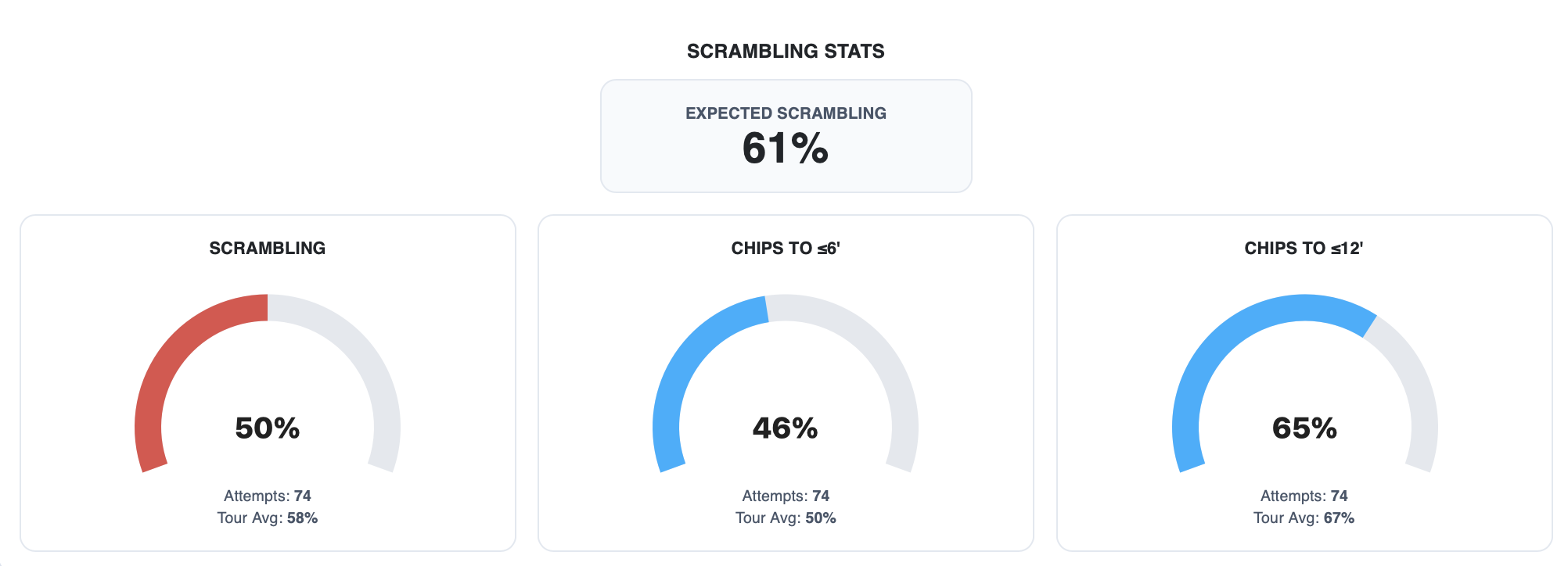
Scrambling percentage is everywhere. Golf broadcasts mention it constantly, amateur golfers track it obsessively, and coaches use it as a shorthand for short game quality. But if you dig into what scrambling actually measures — and more importantly, what it misses — the picture is more complicated than that single number suggests.
This week we are focused on around-the-green performance: what the data actually captures, which numbers correlate with scoring, and how PARfect Performance helps competitive players and college programs understand where they are gaining and losing strokes from inside 30 yards.
What Scrambling Percentage Actually Measures
Scrambling percentage answers one question: when you miss the green, how often do you still make par? It is a binary outcome stat — you either scramble or you do not. A chip to two feet and a hole-out from the rough both count the same. A chip to 10 feet that you make counts the same as a chip to 10 feet that you miss.
That binary structure is the problem. Two players with identical scrambling percentages can have completely different short games. One might be consistently leaving themselves tap-ins. The other might be relying on hot putting to cover up mediocre chipping. The outcome stat does not tell you which is which — and that distinction matters enormously when you are trying to actually improve.
What SG:Around-the-Green Captures Instead
Strokes Gained: Around-the-Green (SG:ARG) measures every shot played from off the green within roughly 30-50 yards. It compares your result — where the ball ends up — to what the baseline player would be expected to leave from the same situation.
The key distinction: SG:ARG rewards proximity. A chip to two feet gains more strokes than a chip to eight feet, even if both eventually lead to pars. The metric tracks the quality of the shot, not just the eventual scoring outcome. That is a meaningful difference when you are trying to understand where your short game is actually breaking down.
PGA Tour Benchmarks Worth Knowing
Here is context for what the numbers look like at the elite level:
- PGA Tour average SG:ARG is 0.0 — the field is the baseline.
- Elite short game specialists gain more than 0.4 stroke per round from around the green. Across a 72-hole tournament, that is a 1-2 shot edge over a field-average short game.
- Tour scrambling percentage typically runs around 58%.
The Lie Type Problem That Most Stats Ignore
One of the underappreciated factors in around-the-green performance is lie variation. Tight lies, thick rough, hardpan, and awkward slopes all require different technique and produce different expected outcomes. A player who struggles specifically from tight lies may look fine in aggregate scrambling data — but their performance in that specific situation is masking a real weakness that shows up exactly when it hurts most: firm, fast tournament conditions.
This is where segmented strokes gained data becomes genuinely useful. When you track lie type alongside your short game shots, patterns emerge that aggregate stats never show. Are you losing strokes primarily from rough? From tight lies? From a specific distance range? Those answers point directly at what to work on.
What to Look for in Your Own Data
If you are using a strokes gained tracking system, here are the patterns worth paying attention to:
- Consistent SG:ARG below benchmark across multiple rounds — this usually points to a proximity issue, not a putting problem. A lot of players blame three-putts on putting when the real issue is leaving themselves 10-footers instead of five-footers.
- Strong scrambling percentage but neutral or negative SG:ARG — this often means you are scrambling well when you chip close, but the chips you leave at six to ten feet are quietly costing you. The binary stat is hiding the damage.
- High variance round to round — if your short game numbers swing wildly, that usually points to inconsistency from specific lies or distances rather than a general skill gap.
Why This Changes How You Practice
The most common mistake competitive golfers make with short game practice is spending time on the shots they already execute well — bump-and-run chips from perfect lies on flat ground. Comfortable shots. The ones that feel good.
SG:ARG data points directly at the gaps. If your numbers show you are consistently losing strokes from 15 to 20 yards in longer rough, that tells you exactly where your practice time should go. Not vague short game work — specific, targeted reps on the exact situations where your data shows a real deficit.
That is the difference between practicing hard and practicing smart.
Conclusion
Scrambling percentage has its place, but it is a results stat, not a quality stat. SG:Around-the-Green tells you how well you are actually executing from around the green, independent of whether the putt goes in afterward. That distinction matters when you are serious about improving.
If you want to start seeing your own around-the-green data this way, PARfect makes it straightforward. Log your round, get your SG breakdowns, and let Parfy surface the patterns worth paying attention to.
Have a look at our previous post to get more insight into the world of golf statistics and PARfect Performance: Why AI Is the Next Competitive Edge in College Golf Analytics