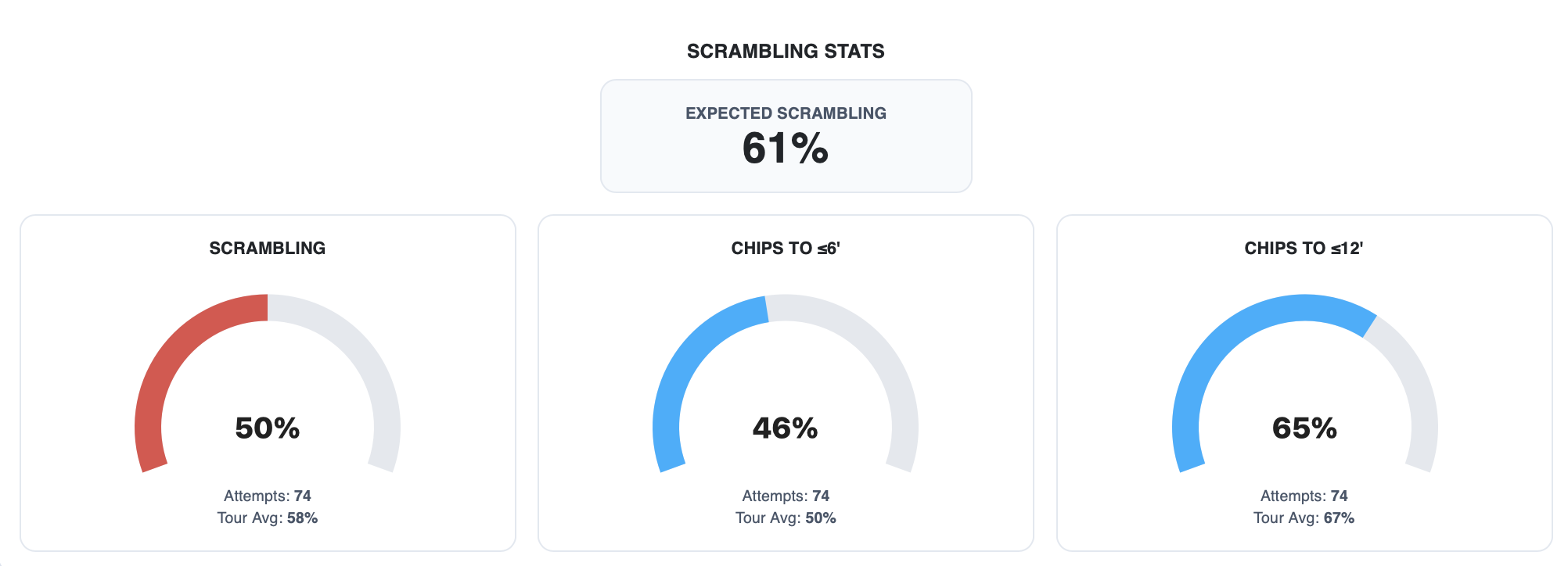
Every golfer has heard the stat: tour average scrambling sits somewhere around 58%. So if you’re saving par 55% of the time from off the green, the easy conclusion is “close enough.” That conclusion is wrong, the real anwser is: IT DEPENDS.
Tour average is the wrong comparison
Tour average scrambling is a single number built from thousands of rounds, thousands of chips played by players whose misses are better, on courses where rough around the greens looks nothing like yours. It’s a good start but it’s an average of all misses, it doesn’t account for ow far from the pin YOU’RE missing shots and what is the rough length on the course you’re playing.
A college player who misses greens by 15 yards with and a player who misses by 30 yards not playing the same short-game puzzle. Judging them against the same 58% benchmark tells you nothing useful about either one.
What “expected scrambling” actually means
Expected scrambling flips the question. Instead of asking “how do you compare to tour average,” it asks: given the specific misses you actually hit — the distances, the lies, how shortsided you were — what scrambling percentage should someone produce from those spots?
PARfect builds this baseline directly from strokes gained data. For every missed green in your rounds, we look at the up-and-down probability tied to that exact distance and lie, rough length, shot difficulty drawn from tour models. Those probabilities get averaged across your actual miss pattern for the period you’re reviewing, which produces one number: your expected scrambling rate.
That’s the number that matters. Not “beat 58%.” Beat YOUR expected rate.
Why this changes how you practice
Once expected scrambling is set as the real benchmark, three things become visible that tour average hides:
- Whether your short game is actually underperforming, or whether your ball-striking is putting you in spots that make scrambling hard no matter how good your short game is.
- Whether upgrading approach play or upgrading short game gives more return. If your actual scrambling rate already matches or beats what your miss pattern should produce, no amount of wedge practice fixes the problem — the leak is upstream, in where the misses are coming from.
How this shows up in PARfect
Inside your around the green stats section, expected scrambling sits next to your actual rate for the period you’re viewing. The gap between the two — not the gap to 58% — is what should be driving your practice plan.
The takeaway: stop measuring your short game against a number built for someone else’s misses. Measure it against what your own game should produce, and let that gap tell you where to practice next.
Missed last week’s post? Read it here.