Fairways hit, greens in regulation, putts per round. For decades, these were the stats golfers tracked, and they all share the same flaw: they do not tell you what to practice.
Strokes gained fixes that. It is the stat the PGA Tour, DP World Tour, LPGA Tour and the best college programs use to find exactly where a player loses shots. I use it every week on tour, and I built PARfect Performance around it.
In this guide I will explain what strokes gained is, how it is calculated, what each category tells you, and how to use it to lower your scores.
What Is Strokes Gained in Golf?
Strokes gained measures how many strokes a shot saved or cost you compared to a benchmark. The benchmark is the average number of strokes it takes a player to finish the hole from a given distance and lie.
If your shot leaves you in a better position than the benchmark expected, you gained strokes. If it leaves you in a worse one, you lost strokes.
The idea was developed by Columbia professor Mark Broadie and later adopted by the PGA Tour, and it not only changed how golf performance is measured, but revolitionized how it is played.
How Strokes Gained Is Calculated
The formula for every shot is:
Strokes gained = (expected strokes before the shot) − (expected strokes after the shot) − 1
The “minus 1” is the shot you just hit.
Here is a simplified example using rough PGA Tour averages:
- From the fairway at 135 yards, a Tour player needs about 2.9 strokes to finish the hole.
- You hit your approach to 10 feet, where the average is about 1.59 strokes.
- Strokes gained = 2.9 − 1.59 − 1 = +0.31
Then you hole the 10-foot putt. Expected strokes before the putt were about 1.59, and after it, 0:
- Strokes gained = 1.6 − 0 − 1 = +0.61
Add up every shot in a round and you get your total strokes gained against the baseline.
You do not need to do this math yourself. A free strokes gained calculator or a stats platform does it for you, but understanding the logic helps you trust the numbers.
The Four Strokes Gained Categories
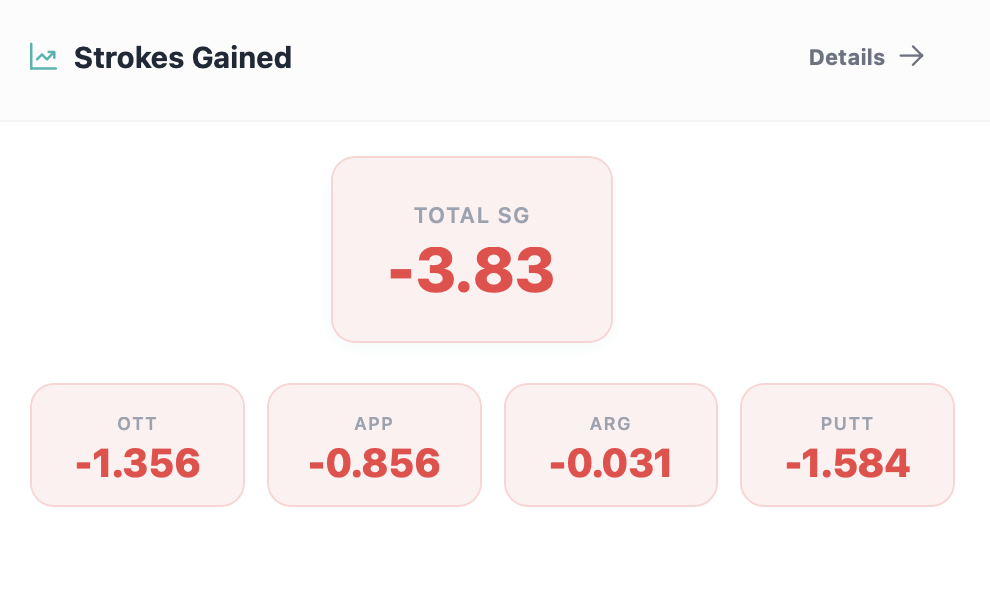
Strokes gained splits your game into four areas, so you can see which one is helping or hurting you.
Strokes Gained: Off the Tee
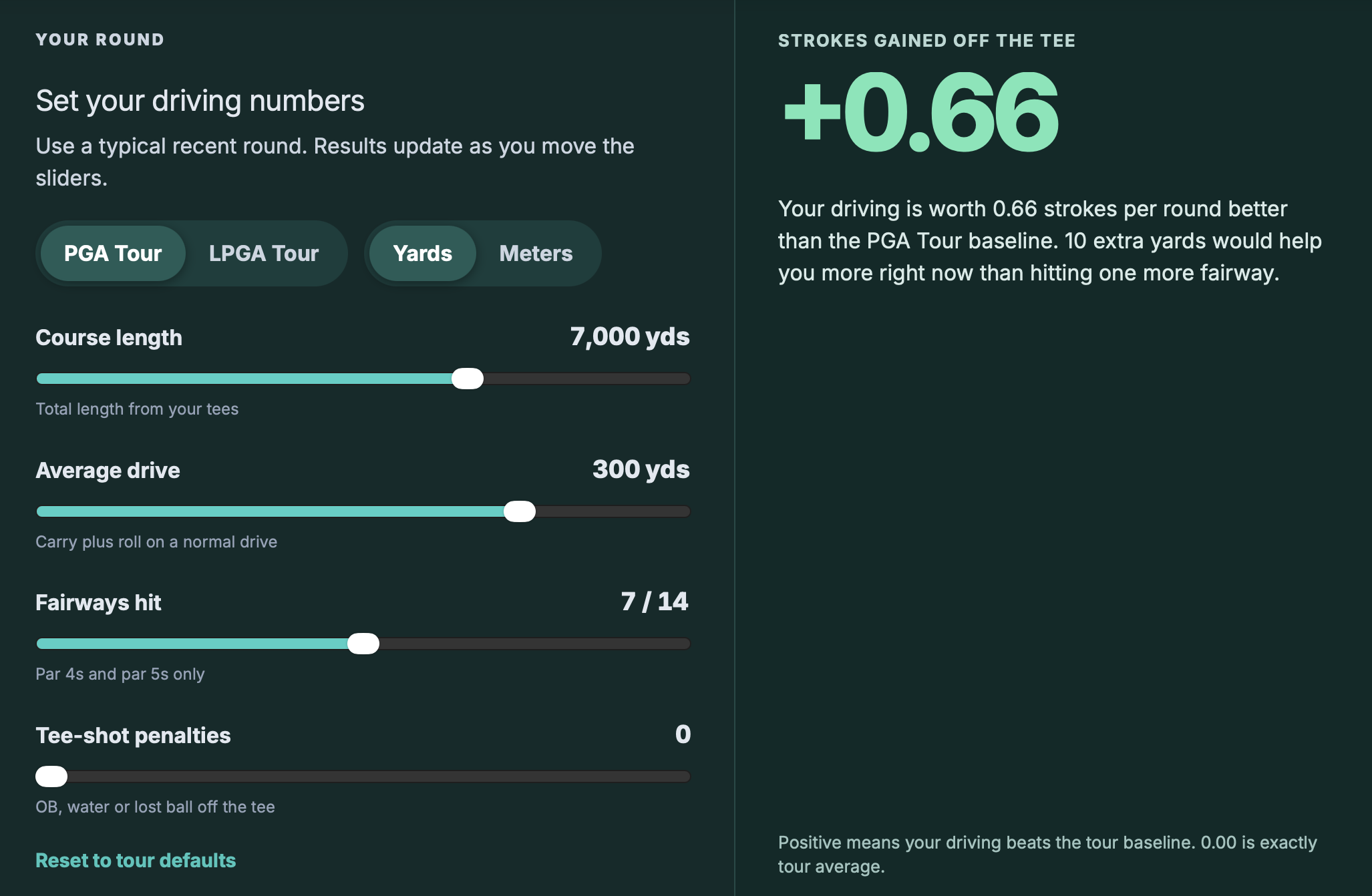
This measures every tee shot on par 4s and par 5s. It rewards distance and accuracy together, which is why a long drive in the rough is not automatically good or bad. For a closer look at what your drives are really doing, read our post on tracking tee shot dispersion.
Strokes Gained: Approach
This covers shots into the green from the fairway, rough, bunker and tee shots on par 3s. Approach play is usually the biggest separator between higher and lower level players. If you want more detail than greens in regulation gives you, see our article on proximity buckets and GIR.
Strokes Gained: Around the Green
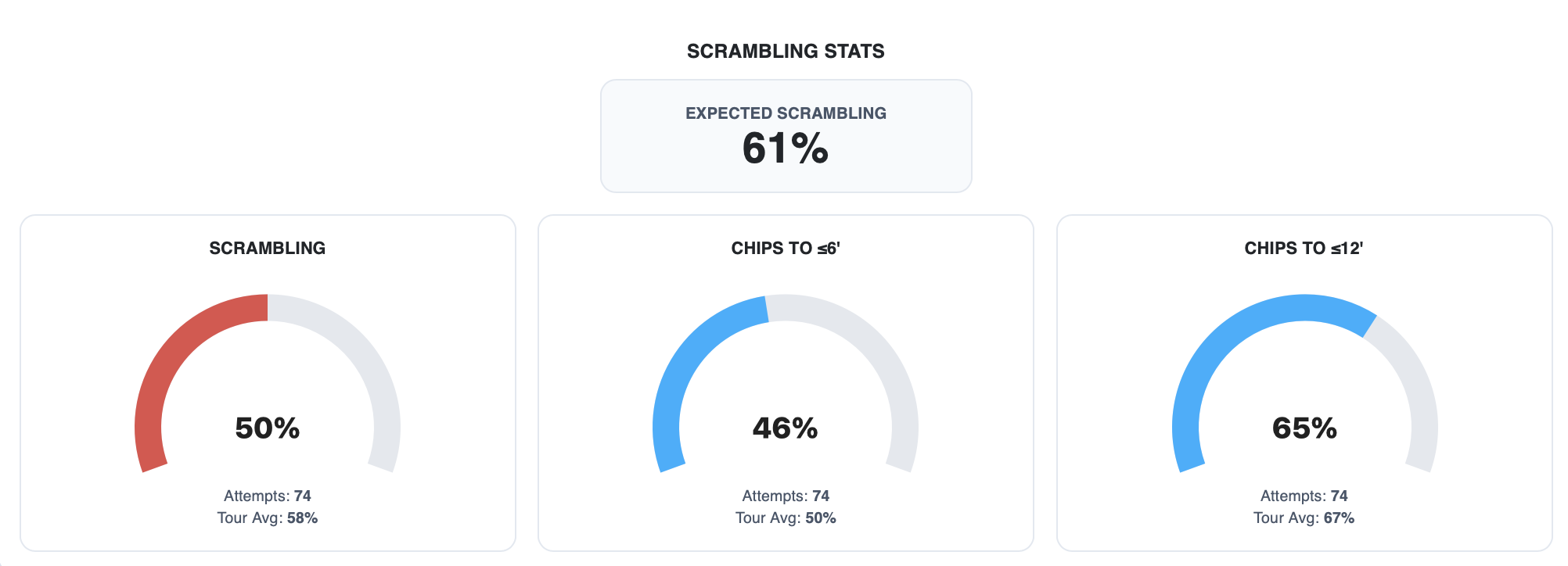
These are shots within roughly 50 yards of the green that do not start on the putting surface: chips, pitches, bunker shots. This category explains why scrambling percentage can mislead you, and we cover what to look at instead in our guide to expected scrambling.
Strokes Gained: Putting
This is every shot hit on the green. Because it accounts for the distance of the first putt, it is far more useful than putts per round. Our post on why putting stats lie explains the difference.
What a Good Strokes Gained Number Looks Like
A strokes gained number of 0 means you performed exactly at the baseline. Positive is better than the baseline, negative is worse.
That raises an important question: which baseline? Comparing yourself to a PGA Tour average is a useful ceiling, and we explain why measuring against tour average still makes you better. But for juniors, women’s programs, and amateurs, age and gender-adjusted baselines give a fairer picture of progress. The goal is not to feel bad about a −2.5 against Tour pros. It is to see which category is furthest from where you want it to be.
How to Use Strokes Gained to Lower Your Scores
Strokes gained is only valuable if it changes what you do. Here is the process I recommend.
- Track full rounds. One round is noise. Aim for a meaningful sample, ideally 20 or more rounds, before making big decisions. If entering a round feels like homework, you will quit, which is why we think round entry has to be simple.
- Find your biggest leak. Compare your four categories. The one with the lowest number is usually where the most strokes are hiding.
- Practice what costs you strokes, not what you feel bad at. The category you dislike is not always the one costing you the most. We break this down in Stop Practicing What You’re Bad At.
- Break the category down further. A weak approach number could come from long irons, wedges, or specific distance ranges. Distance-based breakdowns tell you which shots to work on.
- Practice with variety. Once you know what to work on, make it count with random practice instead of block repetition.
- Recheck every few weeks. Strokes gained is a feedback loop. Practice, play, measure, adjust.
If you have ever felt like you practice a lot without improving, this is probably why you plateau.
Strokes Gained for College and Junior Golf
Coaches are adopting strokes gained because it solves a real problem: interpreting data from an entire roster fast enough to act on it. It gives every player an individualized practice priority, and it gives coaches a common language for conversations about development.
Our articles on why stats are non-negotiable in coaching and why stats matter for junior golfers go deeper on both.
Common Strokes Gained Mistakes
- Judging too early. A single round, or a single category on a single day, tells you very little.
- Ignoring the data you already have. If your stats are not turning into a practice plan, they are just numbers.
- Treating the stat as a verdict. A negative number is a to-do list, not a measure of your ability.
- Tracking too many things. Start with the four categories before adding more detail.
Frequently Asked Questions
What does strokes gained mean in golf?
Strokes gained measures how much better or worse a shot was compared to the average result from the same distance and lie. Positive means you gained strokes on the benchmark, negative means you lost strokes.
How do you calculate strokes gained?
Subtract the expected strokes after the shot and 1 (for the shot itself) from the expected strokes before the shot. Add up every shot to get a round total.
Can amateur golfers use strokes gained?
Yes. Strokes gained works for any skill level because it compares your results to a baseline, then shows you where the largest gap is. Amateurs often benefit the most because they have more room to improve and often misjudge their weaknesses.
What is a good strokes gained putting number?
Zero is equal to the baseline, so anything above zero is better than average for that baseline. What counts as good depends on which baseline you compare against, such as PGA Tour, LPGA Tour, or a handicap-based benchmark.
How many rounds do I need for reliable strokes gained data?
Single rounds are noisy. Ten or more rounds give a much clearer picture of your real strengths and weaknesses but we recomennd looking at at least 20 rounds to see the real trends.
Is there a free strokes gained calculator?
Yes. You can use our free strokes gained calculators for putting and driving, with no signup.
The Bottom Line
Strokes gained tells you where your strokes are going. Your job is to use that information to decide what to practice next. Track your rounds, find the biggest leak, work on it with purpose, and measure again.
If you want to do this without spreadsheets, PARfect Performance turns your round data into stats and your stats into a practice plan. You can start free here.
Michał Bargenda is a professional golfer on the Pro Golf Tour and HotelPlanner Tour, and the founder of PARfect Performance.
Read my previous post: Free Strokes Gained Calculator: Find Where You Lose Shots