You know the feeling. You hit 40 drives to the same flag, find the rhythm around ball 15, and walk off the range convinced you’ve figured something out. Then you get to the course, face a tee shot with trees to the right and water to the left, and that ball is going straight into trouble.
That gap between how you practice and how you play is one of the most common problems I see, and I’ve lived it myself. Let’s break down why it happens, and what we’ve built to help fix it.
Block practice: the comfortable default
Block practice means repeating the same shot over and over. Fifty 7-irons. Thirty 6-footers from the same spot. Twenty bunker shots from one lie.
It has real value. When you’re learning a new movement, like a swing change or a new putting stroke, repetition helps you build a pattern. I’m working through swing changes with my coach right now, and block practice is exactly the right tool for that stage.
The problem is how it feels. Block practice produces fast, visible improvement within the session. Your dispersion tightens, your contact gets cleaner, and you leave feeling good. But a lot of that improvement is short-term. You’re benefiting from the shot you just hit, and the one before it, and the one before that.
Random practice: harder, and better
Random practice mixes skills and situations. A driver, then a 9-iron to a different target, then a 30-yard pitch, then a putt. Every shot is a new problem, and you have to set up, pick a target, and commit, just like on the course.
Motor learning research has looked at this for decades. The classic finding, often called the contextual interference effect (first described by Shea and Morgan in 1979), is that random practice makes performance look worse during practice but produces better retention and better transfer to new situations. In plain terms: you hit it worse on the range, and better on the course.
That’s why random practice feels uncomfortable. Your numbers during the session will often be lower than in a block. That’s not a sign it’s not working. It’s the sign that your brain is doing the work instead of coasting on repetition.
So which one should you use?
Not either/or. A simple way to think about it:
- Learning something new or fixing a flaw: start with block practice to build the pattern.
- Preparing to perform: shift toward random practice so the skill holds up under real conditions.
Most players, especially competitive ones, spend far too much time in the first category long after they’ve moved past the learning stage. The challenge is that random practice takes more planning. Who wants to build a random 60-shot session on the fly, while also tracking how it went?
That’s exactly the problem we set out to solve.
What’s new in PARfect: Practice Challenges
Our Practice Challenges bring structure and a bit of pressure to random practice. Instead of hitting balls and hoping, you work through skill development challenges, rating each shot and scoring the session in real time. You can save your results, track your history, and come back to beat your previous score.
It turns “I’ll just hit some balls” into a session with a target, a score, and a record of whether you’re getting better.
What’s new in PARfect: Round Simulation
This is the one I’m most excited about.
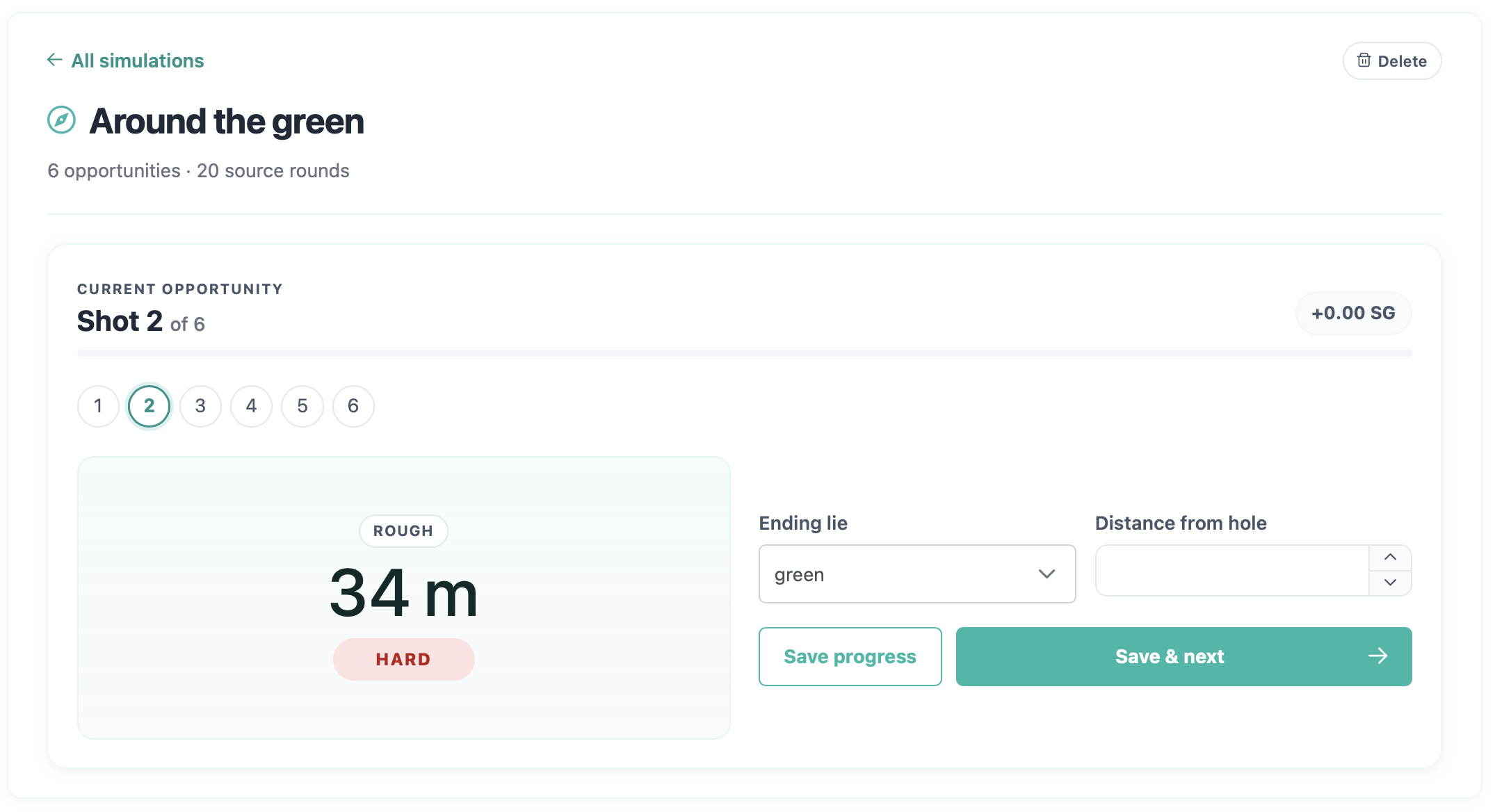
Round Simulation looks at the frequency of every shot you hit per round and uses it to build a random practice session across the four areas of the game: off the tee, approach, short game, and putting.
The logic is simple. If a typical round has a certain number of drivers, a certain mix of approach distances, a certain number of chips and pitches, and a certain number of putts, your practice should reflect that. Not the 80% of range time most players spend on 6 iron shots. Not an even split across everything. A session that mirrors what the game actually asks of you.
A few reasons this matters:
- It matches the demands of the course. Practice time goes where the shots actually happen.
- It’s random by design. Shots come in a mixed order, so you’re always adapting to the next one, the way you do in a round.
- It removes the guesswork. No more building a session from scratch or defaulting to whatever you enjoy hitting.
Think of it as playing a round on the practice facility, without the walking.
How to put it together
Here’s how I’d structure a practice week:
- Warmup: block practice on whatever you’re actively working on, a swing change, a specific distance, a putting stroke.
- Large Bulk of the session: a Practice Challenge to pressure-test those skills with scoring and a Round Simulation, so the session looks like the round you’re about to play.
Block practice builds the skill. Random practice proves it holds up.
The takeaway
If your practice always feels good and your rounds don’t reflect it, the issue may not be effort. It may be that your practice is too comfortable. Mix it up, accept the worse numbers, and let the course be where it shows.
Practice Challenges and Round Simulation are available in PARfect Performance now. Give one a try this week and see how it changes the way a session feels.
Missed last week’s post? Read it here: Beyond GIR: A Deep Dive Into Proximity Buckets and Greens-and-Fringe-in-Regulation.