If you want to stop three-putting, the most common advice is to practice your stroke. Roll a few more putts on the practice green, work on your technique, and hope it gets better.
The research suggests that is not where the biggest gains are. In this post I’ll show what a doctoral dissertation on golf putting found about what really drives putting performance, and how to use that, together with your own stats, to build a practice plan that cuts three-putts.
How Many Three-Putts Per Round Is Good?
Start by counting. A good target is around 0.5 three-putts per round, which is about one every other round. If you’re well above that, three-putts are costing you real strokes: each one is a full shot lost on a hole where two putts was the realistic outcome.
Track them over a few rounds before you change anything. One bad round can make you think you have a problem you don’t, and one good one can hide one you do.
What Really Drives Putting Performance
Jon Karlsen’s 2010 doctoral dissertation at the Norwegian School of Sport Sciences looked at what affects putting performance for elite players (Karlsen, 2010). It is one of the few studies that tries to rank the factors by importance, and it splits putting into two parts: distance and direction.
Distance control
For distance, the dissertation estimated the share of variability each factor causes (Karlsen & Nilsson, 2008b). In order of importance:
- Green reading: about 60%
- Technique: about 34%
- Green inconsistencies: about 6%
In other words, distance errors come mostly from misjudging how fast the putt will roll, not from hitting the ball at the wrong speed.
Direction control
For direction, the order is slightly different (Karlsen, 2010). The most important factor is again green reading, followed by aim, then green inconsistencies, with technique last. For a scratch player, the estimated size of each source of error looks like this:
| Factor | Estimated direction variability (SD) |
|---|---|
| Green reading | about 1.3° to 1.6° |
| Aim | about 0.9° |
| Green inconsistencies | about 0.8° to 1.0° |
| Technique | about 0.5° |
The author is clear that these numbers are estimates and should be used with caution. The green reading figure, for example, comes from calculation, not direct measurement. The direction of the ranking is clear, though: technique is the smallest source of error for the elite players studied.
What this means for you
The study looked at highly skilled players, with mean handicaps of around 3 or lower in the distance study, so the exact percentages may be different for higher handicap golfers. But the main message likely holds: reading the green is where most golfers have the most to gain, and technique is where they spend most of their practice time.
That mismatch is a big part of why people keep three-putting.
Step 1: Find Out Why You’re Three-Putting
Not every three-putt has the same cause, and the fix is different for each. Every three-putt falls into one of two groups:
- Lag putt problem: your first putt finishes too far from the hole, which leaves a long second putt that you miss or leave short.
- Short putt problem: your first putt finishes close, and you miss the short one coming back.
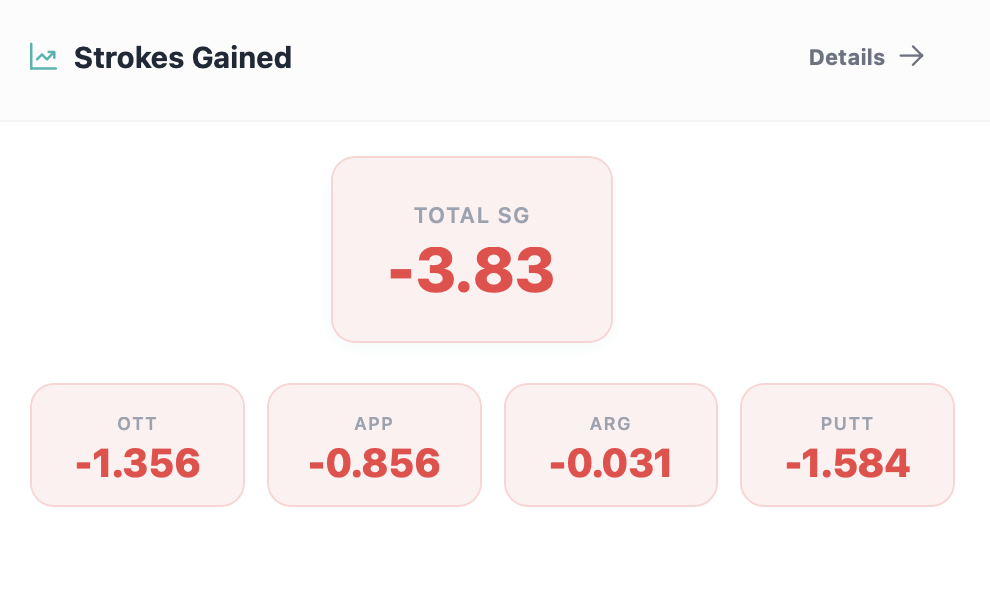
You can’t reliably tell which group you’re in by memory or by feel. A bad round sticks in your head, and one dramatic miss can make you think you have a problem you don’t. To find out, you need to use PARfect. PARfect uses strokes gained calculations to determine whether your three-putts come from lag putt misses or short putt misses, so the answer comes from your numbers over many rounds, not from a guess.
Log a handful of rounds with your putts and check which group dominates. That result tells you exactly what to work on in Step 2.
For more on what to track, see why putts per round is a misleading stat and how slope and break data reveal your putting tendencies. You can also compare your putting to a benchmark with the free strokes gained putting calculator.
Step 2: Turn It Into a Practice Schedule
Knowing the cause only helps if it changes what you practice. Use the Practice Planner in PARfect to turn your result into a schedule you can follow each week:
- If lag putts are the cause, put most of your putting time into green reading and pace control.
- If short putts are the cause, put most of your putting time into green reading, aim, and short putt games.
Short, regular sessions are easier to stick to than one long session, and a schedule means you don’t have to decide what to work on each time you walk onto the practice green.
Step 3: Practice the Cause
If lag putts are the problem: green reading first, then pace control
Lag putting is a distance control problem. In the research, green reading ranked first for distance control (60%), ahead of technique (34%) (Karlsen & Nilsson, 2008b). So green reading comes first, then pace.
- Green reading: PARfect has a green reading tool built for players who read greens with their feet and slope percentages. Pair it with the library of green reading drills and games, which are designed to make you read, commit, and then check how good your read was.
- Pace control: work through the library of lag putt drills and other pace control drills in PARfect. The goal is not to make long putts. It is to finish close enough that the second putt is easy.
If short putts are the problem: green reading, then aim
Short putts are mostly a direction problem, where green reading is again first, followed by aim (Karlsen, 2010).
- Green reading: use the same green reading tool and the same library of green reading drills. Many missed short putts are misreads, because even a two-foot putt can have break.
- Aim: use an alignment board or start line board, plus a string, to check where you are really aimed and whether the ball starts on your intended line. This matters because even elite players are not perfect here: in one study of 20 elite players, they aimed an average of about 1° left of the target (Karlsen & Nilsson, 2008a).
- Put it together with games: once your read and aim are solid, use the performance games in PARfect to combine them into actually holing short putts. Games add a score and some pressure, which is closer to how short putts feel on the course than rolling balls with no stakes.
Technique ranks last for both distance and direction in the research, so it is not where to start. It can matter more under pressure or for players with the yips (Karlsen, 2010).
Step 4: Finish Every Practice With Round Simulation
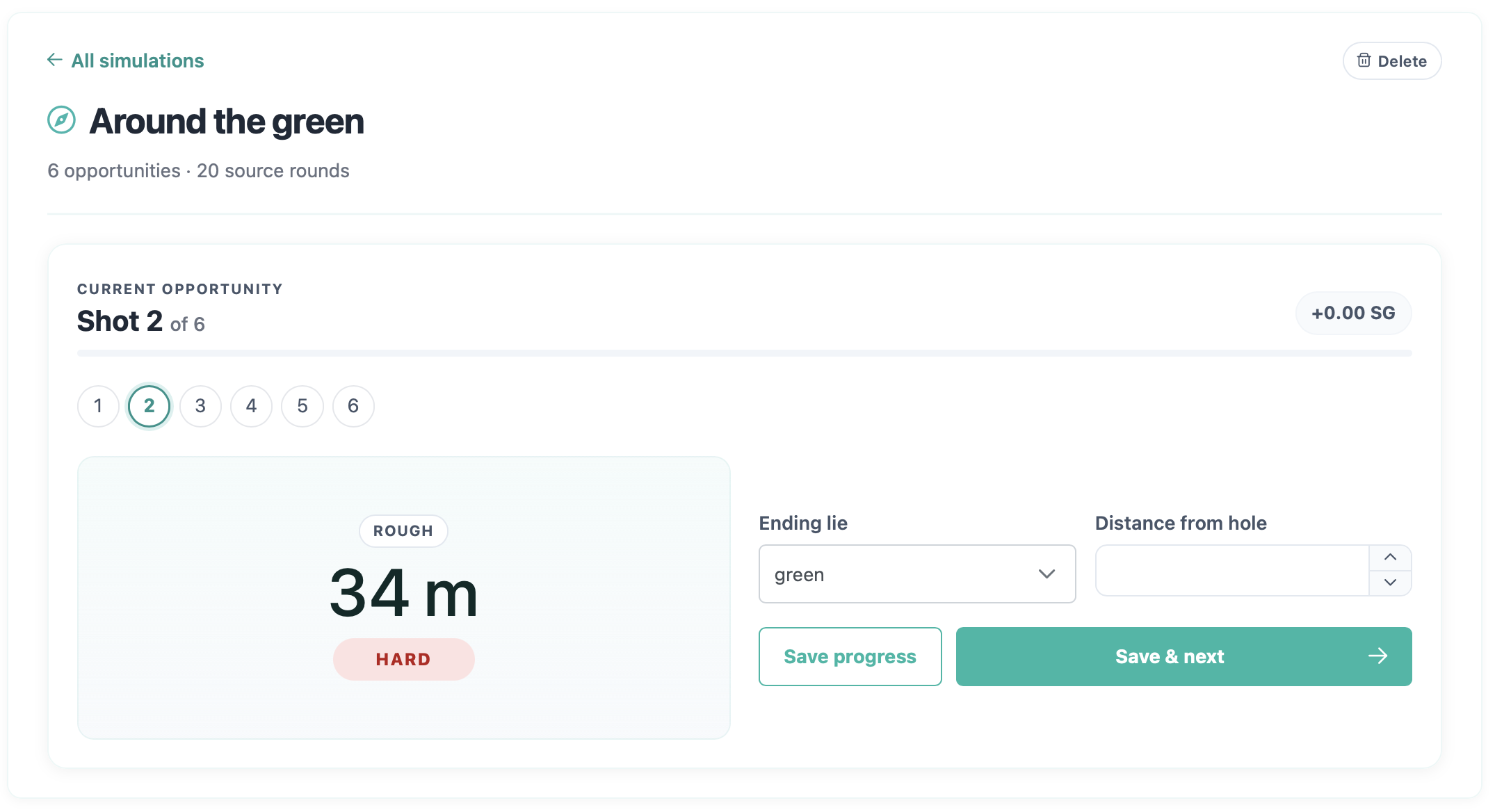
End your putting practice by putting as if you were in a tournament. Use Round Simulation in PARfect to do it. It builds a random session from the putts you actually face most often in your rounds, so you’re not practicing putts you rarely see.
Treat every putt like a real one:
- Use your full routine: read, aim, rehearse, and commit, every time.
- Face random putts: a different distance and break on every putt, with no repeats, just like on the course.
- Practice the putts you really hit: because the session is based on how often each putt shows up in your rounds, your practice looks like your rounds.
This is where the work from Step 3 gets tested the way you will use it. For more on why random practice transfers better to the course, read my post on block vs random practice.
You can try all of this with the individual one-month free trial at parfectperformance.com.
Frequently Asked Questions
What causes three-putts?
Most three-putts come from either a poor first putt that leaves a long second putt, or a missed short putt. Research on elite players suggests that misjudging the green (its slope and speed) causes more variability than the stroke itself (Karlsen, 2010).
How many three-putts per round is normal?
A good target is about 0.5 per round, or one every two rounds. Higher numbers are common among amateurs.
How do I improve my lag putting?
Focus on green reading and pace control. Practice from different distances and slopes, use lag putt drills that reward finishing close, and aim to finish inside a landing zone around the hole instead of trying to make every long putt.
Does putting technique matter?
Yes, but for the elite players studied, it was less important than green reading for both distance and direction control. Technique can matter more under pressure, or for players with the yips.
The Takeaway
To stop three-putting, find out in PARfect whether lag putts or short putts are the cause, turn that into a practice schedule, and put green reading first in every session. Then finish each practice by putting like it’s a tournament round.
References
Karlsen, J. (2010). Performance in golf putting [Doctoral dissertation]. Norwegian School of Sport Sciences, Oslo.
Karlsen, J., & Nilsson, J. (2008a). A new method to record aiming in golf putting: Applied to elite players. In D. Crews & R. Lutz (Eds.), Science and Golf V: Proceedings of the World Scientific Congress of Golf V (pp. 395–401).
Karlsen, J., & Nilsson, J. (2008b). Distance variability in golf putting among highly skilled players: The role of green reading. In S. Jenkins (Ed.), Annual Review of Golf Coaching 2008 (pp. 71–80).
Missed last week’s post? Read it here: What Is Strokes Gained in Golf? A Complete Guide for Players and Coaches